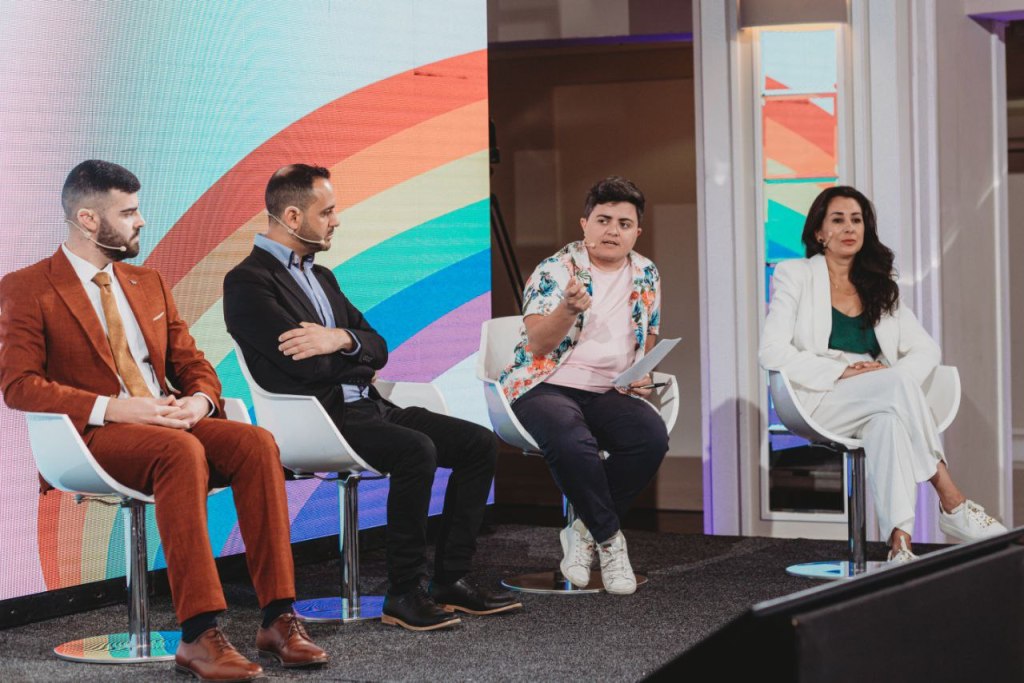
Yesterday I spoke on a panel about Maltese language and it’s binary and non-binary modes.
This would be just another event in the life of an activist, weren’t it for the fact that I barely spoke a word of Maltese the first 18 years of my life. To think that now I’m able to not only participate in a conversation in Maltese, but deconstruct and construct the language, on a panel about the language is amazing.
It’s not too long ago that I would receive comments from people during campaigns, telling me my way of speaking Maltese would harm the causes I was fighting for. Just yesterday someone told me she had always assumed I could not speak the language at all, because my Sardinian surname marks me as foreign.
But just like gender, we can’t assume the languages a person speaks just by looking at them or reading their name.
It’s with this awareness in mind that when I share my pronouns, I try to avoid saying they/he. Instead I say, “neutral if possible, masculine if not.” This prepares people to talk about me in all their languages.
Because when we talk about “they/them” pronouns people often use it as a shorthand for non binary people. But it’s not and it shouldn’t be made into one. Firstly because there are many non binary people who don’t use these pronouns. Secondly because in many languages it is not just about pronouns, but about many other elements. Thirdly because the value of neutral language is not just about and for non binary people, but about challenging the masculine norm.
Yet somehow, from the many things trans and non binary people talk about, pronouns is one of the few that we’re listened to about. But when you do listen, i ask that you are aware of the nuances as well.
Thanks to the Human Rights Directorate for inviting me to speak on this panel. To Clare Agius for the great moderation, and to my fellow panelists Romario Sciberras, Dr Michael Spagnol and Dr Claire Azzopardi Lane for the great conversation.
Photo: DOI / Government of Malta
 MJ Tolu
Leave a comment